Code
Here is a very silly function:
\[ h(x) = \exp\left(-\frac{1}{2}\frac{(x-\mu)^2}{\sigma^2}\right) ,\quad -\infty<x<\infty . \]
Treat \(-\infty<\mu<\infty\) and \(\sigma>0\) as constants and compute the value(s) of \(x\) at which \(h\) has inflection points.
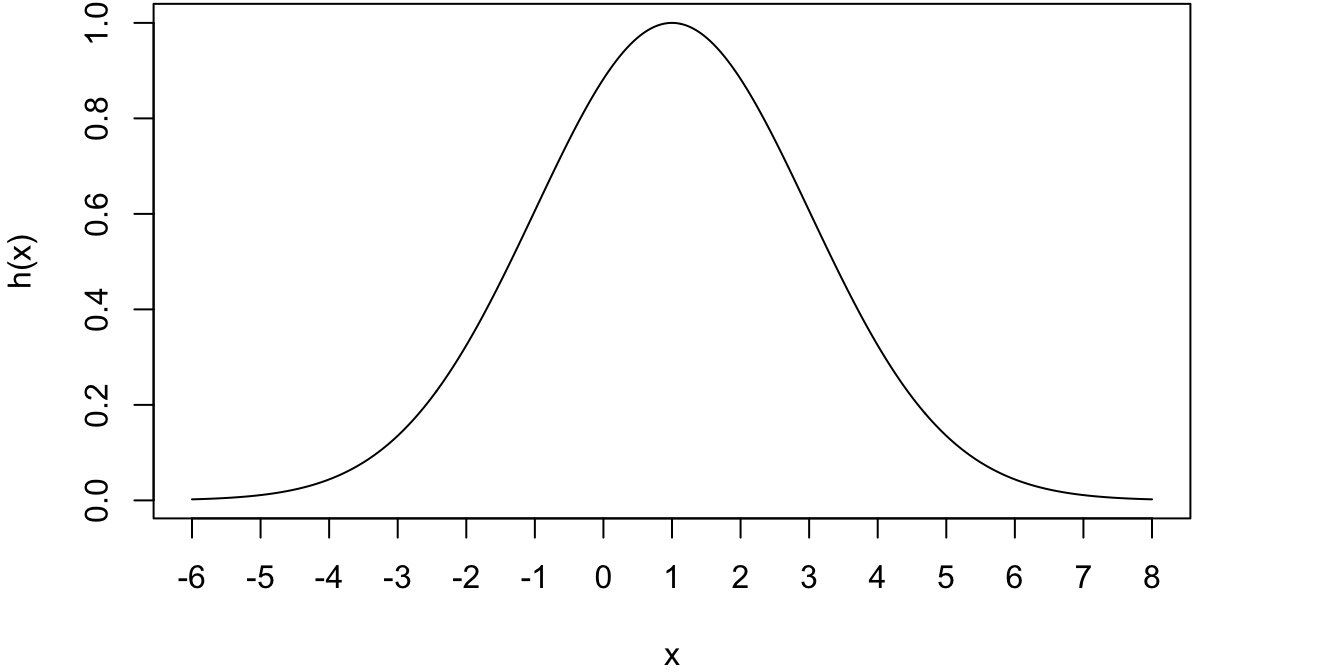
Here is an example of what \(h\) might look like in the special case where \(\mu = 1\) and \(\sigma=2\):
Before you start doing any math, can you use the picture to guess what the answer will be?